Category: linguistic

  • Học chậm #1

    Tóm tắt: Agile, Scrum, software, dystopia, working mom, language learning

    1. Agile & Scrum?

    Hỏi: Agile và Scrum giải quyết vấn đề gì?

    Đáp: Agile ra đời để tăng tính linh hoạt trong phát triển phần mềm, giúp phản hồi nhanh với thay đổi và cung cấp giá trị sớm hơn so với Waterfall. Scrum cụ thể hóa Agile bằng cách tổ chức công việc theo các chu kỳ ngắn (Sprint), tạo sự minh bạch và cải thiện hợp tác nhóm. Cả hai đều giúp giảm rủi ro và tối ưu hóa kết quả trong môi trường không ngừng thay đổi.

    Từ vựng mở rộng:

    • Software Development Life Cycle:
      • Khái niệm SDLC hình thành vào thập niên 1960-70 nhằm giải quyết sự phức tạp ngày càng tăng trong phát triển phần mềm, đặc biệt sau khủng hoảng phần mềm. Nó cung cấp một khung lý thuyết với các giai đoạn rõ ràng như yêu cầu, thiết kế, phát triển và bảo trì để đảm bảo chất lượng và quản lý chi phí. Mô hình Waterfall là một trong những cách triển khai đầu tiên của SDLC.
    • Waterfall (được Winston W. Royce trình bày năm 1970) là một trong những mô hình SDLC đầu tiên, nhấn mạnh quy trình phát triển theo từng bước rõ ràng.
    • Software crisis (1960s)
      • Thuật ngữ này được đặt ra vào cuối thập niên 1960, khi các dự án phần mềm liên tục thất bại do không đáp ứng được tiến độ, ngân sách hoặc chất lượng mong đợi.
      • Trước 1960, phần mềm tồn tại nhưng không được xem là một sản phẩm có “vòng đời” cần quản lý chặt chẽ. Phần mềm lúc đó chủ yếu phục vụ mục đích cụ thể, nhỏ lẻ, và không có sự phân biệt rõ ràng giữa phát triển, thử nghiệm, và bảo trì. Chính sự gia tăng về quy mô và chi phí của phần mềm vào thập niên 1960-70 đã dẫn đến nhu cầu quản lý vòng đời phát triển phần mềm, đặt nền móng cho SDLC và các phương pháp phát triển hiện đại như Agile và Scrum.
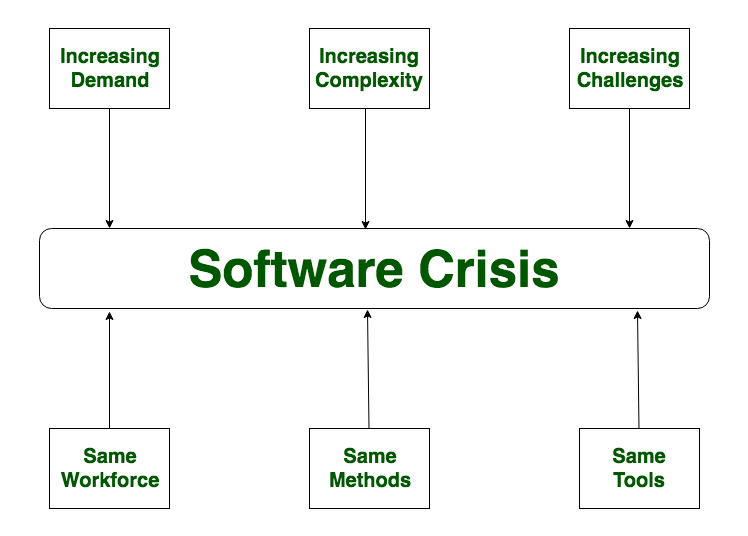
    Nguồn ảnh: https://www.geeksforgeeks.org/software-engineering-software-crisis/

    PMBOK Handy Guide: https://www.eyapro.com/project-management/pmbok-7th-handy-guide

    2. Career and Family

    Tuần này Giang đã dịch xong chương 1 của cuốn Career and Family. Thú vị nhưng hơi nặng nề. Giang sẽ trích dẫn vào tuần sau nhe.

    3. Danh sách từ vựng “đầu tiên” khi học bất kì một ngôn ngữ mới?

    Gần đây Giang đang quay lại việc học ngoại ngữ (tiếng Nhật và tiếng Đức). Câu hỏi Giang đặt ra là, liệu có chăng một danh sách các từ thông dụng phổ biến ở hầu hết các ngôn ngữ, để người học có thể bắt đầu? Sau đây là các danh sách mà Giang tìm được:

    • First 625 Words (Gabriel Wyner): 625 từ, tập trung vào những từ cụ thể, dễ hình dung, phù hợp cho người mới bắt đầu, có 2 phiên bản xếp theo alphabet hoặc theo chủ đề; nhưng thiếu cơ sở khoa học, không phản ánh tần suất sử dụng thực tế.
    • Swadesh List: gồm 100 hoặc 207 từ, phù hợp để so sánh ngôn ngữ học lịch sử, nhưng không thực tế cho giao tiếp hàng ngày.
    • New General Service List (NGSL): 2818 từ hiện đại trong tiếng Anh
    • Academic Word List (AWL): 570 word families, tập trung vào ngữ cảnh học thuật, không phù hợp để giao tiếp cơ bản.
    • COCA Frequency List: Phản ánh ngôn ngữ hiện đại, dựa trên corpus lớn, và (vẫn) chỉ áp dụng cho tiếng Anh Mỹ.

    Với nhu cầu của bản thân, Giang sẽ bắt đầu với First 625 words để có cảm hứng, đọc hiểu được một số meme và truyện tranh, kế đó Giang sẽ chuyển qua NGSL để giao tiếp cơ bản, và sau đó là AWL để có thể đọc sách non-fiction và xem phim tài liệu. Nhân đây Giang cũng mới kiếm ra cái tool này thể hiện mối liên hệ giữa các từ như một cái map, mời bạn coi chơi: https://wordmapdictionary.com/

    Tuần này Giang đã coi và đọc:

    Phim:

    1. When the phone rings: 4.5 sao, chủ đề tưởng tổng tài 3 xu mất não nhưng mà càng coi càng thấy biên kịch làm tốt phần xây dựng nhân vật và truyền tải nhiều thông điệp hữu ích
    2. Upstream: 5 sao, vừa coi vừa rớt nước mắt, chủ đề nặng nề và thực tế

    Sách (chưa đọc xong cuốn nào hết trơn…)

    1. Từ xác định đến bất định
    2. Lịch sử vú
    3. Lịch sử vợ
    4. Về bản tính người

    Sách chờ đọc:

    1. Big Fat Notebook: Computer Science and Coding
    2. Origami Việt Nam chuyện của giấy: mua vì nhớ ông anh Hai của mình quá xá https://origami.vn/

    Một tuần mới lại đến. Chúc tụi mình nhiều nhiều sức khỏe nha

    Giang Nguyen, 2025.01.05

  • The importance of Latin

    Ancient:

    Spoken by the Romans, who conquered a large area in Europe.

    Modern:

    • Spanish, French, Portuguese, Italian, Rumanian are simple modern Latin.
    • Many words in common use in these language come from original Latin form.
    • No influence in Swizerland and Austria but in South America & part of North America.

    English

    Half of English words are derived from Greek & Latin.

    New words

    • Name of inventions
    • Special terms used in chemistry, botany, physics and other scientific studies.

    Law & medicine

    Form of English derivatives from Latin:

    Most of the words derivatives from Latin to English changed in their forms. Their meanings retain the same or nearly the same meaning as in the original Latin.


  • Latin – Introductory – Pronunciation – Accent

    Benefits to study Latin

    One of the chief value to be gained from studied Latin is a better knowledge of the English language:

    • a clearer comprehension of grammartical structures
    • enlarged vocabulary & increased accuracy in the use of words

    PRONUNCIATION

    I. Alphabet

    The same as Eng. Except no w.

    II. Vowels: a e i o u & y (1)

    Consonant: the rest

    Roman method of Pronunciation

    III. Short & long vowels

    IV. Consonants

    V. Dipthongs

    VI. Syllables

    VII. Length of syllables

    1. Long: contains a long vowels/dipthong

    2. (regularly) long: its vowel is followed by 2 consonants: con-do, mit-to

    Note: short: 2 consonants consist of a mute (*) followed by or 

    (*) the mutes: b p c k q g d t ph th ch

    3. All others: short

    Note: long: if a vowel followed by x & z

    x & z : double consonant (combination of sounds => have the value of 2 consonants)

    ACCENT

    VIII. The prominence in pronunciation given to a syllable iss called accent. 

    Eg: Accent: the prominence falls on the first syllable.

    Rules for accent in Latin words:

    IX. 1. 2 syllables: accent falls on the first lu’-men

    2) more than 2 syls:

    the syl before the last (penult) if it’s long, 

    otherwise the second before the last (antepenult) 

    Sài Gòn, 7/4/2017

    Comment:

    Khi học tiếng Latin, điều mình phân vân là: Latin đã là tử ngữ, có nhất thiết phải đọc thành tiếng? Tuy nhiên, Wheelock khuyên vẫn nên đọc thành tiếng, mục đích là để tạo cảm giác lên giác quan. Hơn nữa, dù ít dù nhiều, đọc thành tiếng vẫn có nhiều ứng dụng, ví dụ như đọc tên thuốc, tên cây cỏ…

    Về hướng dẫn phát âm, bạn có thể vào đây nhé: http://www.vncreatures.net/all_news/latinread.php

  • Coursera: Introduction to Linguistic – Reading materials

    Miracles of Human Language: An Introduction to Linguistics

    by Universiteit Leiden & Meertens instituut (KNAW)

    Prof: Marc van Oostendorp

    In this course, there are two types of readings:

    Required readings: These are part of the official course materials. You will be tested on your knowledge and insight into the required readings in weekly quizzes and in the final exam.

    Background readings: These are not part of the official course materials but are recommended for those of you who want to gain a deeper knowledge into the subjects of that week. You will not be tested on this material in the weekly quizzes or the final exam, but we still encourage you to read some of this material. Please note that some of the recommended readings might not be open-access. They could be behind a pay-wall or in the case of books, you need to purchase them somewhere. Unfortunately, there is still little material available free of charge.

    Resources: In this first module, you will find also find some general background reading, as well as some good online resources.

    Required Readings

    Anderson, Stephen R. “How Many Languages are there in the World?” Linguistic Society of America Brochure Series, 2010 Click here to read.

    Jackendoff, Ray. “How did Language begin?” Linguistic Society of America. Click here to read.

    Dasgupta, Shreya. “Can any animals talk and use language like humans?” BBC Online, 16 Februari 2015. Click here to read.

    “Language Status” Lewis, M. Paul, Gary F. Simons, and Charles D. Fennig (eds.). Ethnologue: Languages of the World, Seventeenth edition. Dallas, Texas: SIL International. Online version, 2014. Click here to read.

    “The Waggle Dance of the Honeybee.” Georgia Tech College of Computing, 2011. Click here to watch.

    Background Readings

    Michael Tomasello (2010). “Origins of Human Communication”. Massachusetts: MIT Press. Click here for more information.

    Steven Pinker (1994). “The Language Instinct: How the mind creates language”. New York: Harper Perennial Modern Classics. Click here for more information.

    Victoria A. Fromkin, Robert Rodman, Nina Hyams (2013). “An Introduction to Language.” 10th ed. Wadsworth: Cengage Learning. Click here for more information.

    Noam Chomsky (2006). “The Architecture of Language”. Oxford India Paperbacks. Click here for more information.

    Guy Deutscher (2006). “The Unfolding of Language: An Evolutionary Tour of Mankind’s Greatest Invention”. Holt Paperbacks. Click here for more information.

    Joel Davis (1994). “Mother Tongue: How Humans Create Language. Birch Lane Press.” Click here for more information.

    Resources

    How to get access to Ethnologue?

    LanguageLog. Blogposts on news, new articles and observations by several renowned linguists, among which Mark Liberman and Geoffrey Pullum. Click here to read.

    Babel. Language Magazine featuring everything from Chinglish to Shakespeare. Click here for more information.

    Bergmann, A., Hall, K.C., & Ross, S.M. (Eds.). (2011). “Language files: Materials for an introduction to language and linguistics”. 11th ed. Columbus, OH: Department of Linguistics, The Ohio State University. Click here for more information

    Linguistic Society of America. This organisation publishes one of the most important scholarly journals in linguistics, appropriately called Language. However, they have also published a plethora of free pamphlets on a wide variety of linguistic topics, written by pre-eminent scholars. Some of these we are allowed to use in this MOOC (for which we are very grateful), and there are many more on their website. Click here for more information.

  • What we use language for?

    1. Communicate ideas
    2. Think
    3. Show who we are, which group of human beings we blong or want to belong to

    Intended group:

    People without language:

    • Wolf children: children growing up without parents or language
    • Physical and psychological abuse

    E.g: Genie. be locked in a room from 20 months old to 13. No human interaction. Father: barked at her. Mother was not allowed to talk to her. => can’t figure out the system of combine all these work into definitely

    • People who lose their language:
    • Aphasia: the (partial) loss of language abilities due to brain damage

    Language is common to all human beings


  • Human Language

    Coursera

    ? What is language?

    3 dimensions:
    1. Descrete infinity: Language is infinite!

    descrete = limited = countable

    E.g: alphabet system. limited set. unlimited words.

    apes can’t do that. they can have some simple combination, but they can’t combine them to make more and more complicated system.

    2. Displacement

    In time

    In place

    Abstract notions

    E.g: Bees can communicate about space, because they can dance and wiggle and tell other bees where to find their honey. Can only talk about what they have really seen.

    3. Joint attention

    Human language expresses a share goals.

    Language is inherently cooperative

    Animals do have system of communication

    SUMMARY

    Human communication:

    • Infinite message with finite means
    • Talk about things not in here and now
    • Language is a fundamentally cooperative tool

    WE USE LANGUAGE:

    • To communicate ideas
    • To think
    • To show who we are, which group